
Tennis Scalping WTA
-
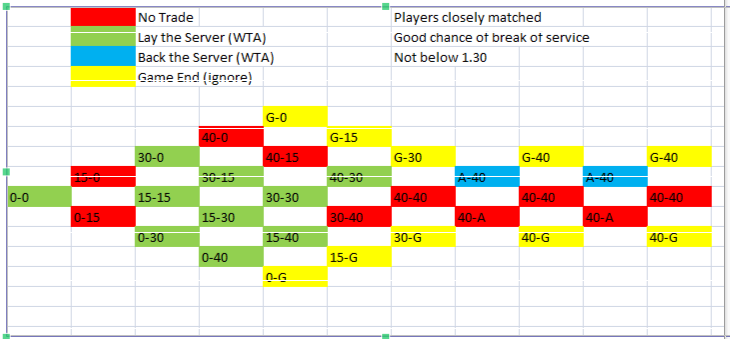
Just checking if some one is into scalping WTA on daily basis (?)
"Here's my simplified explanation of a tennis trading strategy I learned from an article by [TradeShark]. This is my interpretation written for beginners."
Cheers
-
Tennis Trading for a 10-Year-Old
Part 7: The Complete Trading Plan
Now let's put everything together.
Imagine you are learning to ride a bicycle.
You don't try tricks on day one.
You learn the basics first.
The article says the same thing.
Step 1
Choose a good match.
Look for:
✓ Similar skill levels
✓ Competitive match
✓ Good liquidity
✓ Chance of service breaks
Avoid:
✗ Huge favourites
✗ Very low odds favourites
✗ Poor liquidity
Step 2
Pick Only 2 or 3 Entry Points
Do not trade every score.
The article specifically recommends focusing on a few situations.
Examples:
15-15
15-30
0-30
Learn those first.
Become comfortable.
Master them.
Step 3
Enter The Trade
Place your back or lay position.
Before the next point starts.
Now wait.
Step 4
Watch The Next Point
This is important.
You are not predicting the whole match.
You are mostly trading the next point.
If the point goes your way:
Great.
Take profit.
Or continue if the next score creates another strong setup.
Step 5
Cut Losses Quickly
This is where beginners struggle.
The article repeats this idea many times.
If the point goes against you:
Exit.
Take the small loss.
Move on.
Do not hope.
Do not pray.
Do not argue with the market.
Just exit.
Step 6
Hedge
After the trade finishes:
Green up.
Lock in profit.
Reset.
Look for the next opportunity.
The Biggest Mistake Beginners Make
Beginners often think:
"I need to be right every time."
Wrong.
Professional traders know they will lose many trades.
The goal is:
Lose small.
Win bigger.
Repeat.
The Entire Strategy In One Paragraph
Find score situations where a break of serve might happen.
Enter trades where the possible profit is larger than the possible loss.
If the next point goes against you, exit immediately.
If it goes your way, take profit or continue when the next score creates even more pressure.
Repeat this process many times during the match while protecting your money with small losses and disciplined exits.
That is the entire strategy explained as simply as possible.
-
Tennis Trading for a 10-Year-Old
Part 6: Liquidity, Market Gaps and Why They Matter
Now we talk about something that confuses many new traders.
Liquidity.
It sounds complicated.
But it is actually simple.
What Is Liquidity?
Liquidity means:
How many people are betting in the market.
Imagine two lemonade stands.
Stand A:
100 customers.
Stand B:
3 customers.
Which stand can buy and sell lemonade more easily?
Stand A.
That is high liquidity.
The same thing happens in trading.
Lots of people buying and selling = high liquidity.
Very few people buying and selling = low liquidity.
Why Is High Liquidity Better?
Because trades get matched quickly.
You can enter easily.
You can exit easily.
You can take profits easily.
You can cut losses easily.
Everything becomes smoother.
What Is A Gap?
Imagine this:
Best back price = 2.00
Best lay price = 2.10
That is a big gap.
The true value is probably somewhere in between.
But nobody is offering those prices.
Why Is This Bad?
Because you immediately start with a disadvantage.
Imagine buying a toy for $10.
Then discovering everyone else will only pay $9.
You start with a loss.
That is what happens when spreads become too wide.
What The Article Suggests
Do not blindly accept the offered price.
Instead:
Place your order a few ticks better.
Wait for someone to match it.
This helps you get closer to the true market price.
Which Markets Are Best?
Good trading markets usually have:
- Lots of money matched
- Lots of active traders
- Small spreads
- Fast matching
Bad trading markets usually have:
- Little money matched
- Huge gaps
- Slow matching
- Erratic movements
Professional traders often skip bad markets completely.
Sometimes the best trade is no trade.
-
Tennis Trading for a 10-Year-Old
Part 5: Why Men's and Women's Tennis Are Different
One of the most important things in the article is understanding that not all tennis matches behave the same.
A trade that works well in one match can be terrible in another.
ATP = Men's Tennis
In men's tennis, many players have very strong serves.
Think of a serve like a superpower.
Some players can serve:
- Very fast
- Very accurately
- Lots of aces
An ace means:
The opponent doesn't even touch the ball.
Easy point.
Because of this, men's players often hold their serve.
That means:
Server starts game
Server wins game
Server starts game
Server wins game
Again and again.
What Does This Mean For Traders?
If a strong male server falls behind:
0-15
or
15-30
or even
30-40
there is still a good chance he recovers.
The market knows this.
So traders are often more careful when laying the server.
WTA = Women's Tennis
Women's tennis is usually different.
There are still strong servers.
But breaks of serve happen much more often.
A player can be:
30-0 ahead
and suddenly become
30-40 behind.
This happens much more frequently than in ATP.
Why Traders Like WTA
Because service breaks create big price movements.
And big price movements create opportunities.
Many of the article's favourite setups become even stronger in WTA matches.
Examples:
- 15-15
- 15-30
- 0-30
- 30-30
These situations often create pressure that leads to breaks of serve.
Simple Way To Remember
ATP:
Strong serves.
Fewer breaks.
More caution when laying servers.
WTA:
More breaks.
More volatility.
More opportunities for lay-the-server strategies.
-
Tennis Trading for a 10-Year-Old
Part 4: What Is a Tick?
A tick is a tiny movement in price.
Think of it like moving one step up a staircase.
Example:
2.00
2.02
2.04
2.06
Each step is a tick.
Traders count ticks because that is how they measure profit and loss.
Example
You buy at:
2.00
Then sell at:
1.96
You made several ticks.
Good trade.
If the opposite happens:
You lose ticks.
Bad trade.
Why Do Traders Love Ticks?
Because small profits happen many times.
Maybe:
+4 ticks
+5 ticks
-2 ticks
+6 ticks
-3 ticks
+7 ticks
The goal is not huge wins.
The goal is lots of small positive results.
Like collecting coins in a jar.
Eventually the jar becomes full.
What Is Hedging?
Imagine two players:
Player A
Player B
You currently have profit only if Player A wins.
That is risky.
Hedging means spreading the profit.
Now you make money no matter who wins.
Traders call this:
Greening up.
You turn one possible profit into a guaranteed profit.
Green Book
A green book means:
Profit on every outcome.
No matter who wins.
You are happy.
Everything is green.
Example:
Player A wins = +$10
Player B wins = +$10
Green book.
Red Book
A red book means:
Loss.
Example:
Player A wins = -$5
Player B wins = -$5
That is a red book.
Nobody likes red books.
But good traders accept small red books when necessary.
Why Small Losses Matter
Imagine two traders.
Trader 1:
Loses $2
Loses $2
Loses $2
Wins $10
Wins $10
Total = +$14
Trader 2:
Refuses to take losses.
Holds losing trades.
One trade becomes:
-$25
Now all earlier profits disappear.
This is why traders cut losses quickly.
Small losses are normal.
Big losses are dangerous.
The Secret Rule
The entire article can almost be reduced to one sentence:
Take small losses.
Let bigger wins happen.
That is the foundation of the strategy.
-
Tennis Trading for a 10-Year-Old
Part 3: The Remaining Scores
Now we look at the rest of the score situations.
Remember:
The trader is always asking:
"Can I lose a little but win a lot?"
If the answer is yes, the trade is interesting.
If the answer is no, the trader usually stays out.
40-0
The server is almost certain to win the game.
The score is:
40-0
The article says:
Usually NO TRADE.
Why?
Most of the odds movement has already happened.
Think of a race.
If one runner is almost at the finish line, there is not much room left for the price to change.
The opportunity has mostly gone.
Some traders may:
LAY the server.
Why?
Because the market acts as if the game is already over.
If the receiver somehow fights back, the odds can move nicely.
But this is more of a bonus opportunity than a core strategy.
40-15
Very similar to 40-0.
The server is still in a strong position.
Again:
NO TRADE.
Most of the important price movement has already happened.
There is not enough value left.
40-30
Now things become interesting again.
The server only needs one point.
But the receiver is still alive.
The article sometimes likes:
LAY SERVER.
Especially in women's tennis.
Why?
If the receiver wins:
40-40
Suddenly the game is completely open again.
The pressure returns.
Odds move in our favour.
However...
If the server wins the next point:
Game over.
Trade loses immediately.
That is why this is considered a brave trade.
Not one for beginners.
40-40 (Deuce)
This is called DEUCE.
At deuce, somebody must win two points in a row.
The article says:
Usually NO TRADE.
Why?
Many people look at deuce and think:
"This is exciting!"
But excitement is not the same as value.
Even though the receiver could break serve, the server still wins most service games overall.
The author feels there is too much uncertainty.
Not enough edge.
So most of the time:
Stay out.
0-15
The receiver wins the first point.
The server is slightly behind.
The article says:
Usually NO TRADE.
Why?
One point is not enough information.
The game has only just started.
Either player could still easily win the game.
Some traders may back a very strong male server here.
Because they believe the server will recover.
But generally:
Wait for a better opportunity.
0-30
One of the favourite setups.
The receiver has won the first two points.
The server is now under pressure.
The trader likes:
LAY SERVER.
Why?
Imagine the receiver wins the next point.
The score becomes:
0-40
Three break points.
That is huge pressure.
The odds move strongly.
Nice profit potential.
Now imagine the server wins:
15-30
Not ideal.
But the damage is usually manageable.
This is exactly what traders want:
Small risk.
Big reward.
Many traders consider 0-30 one of the best entry points in tennis trading.
0-40
The receiver has three break points.
The article says:
LAY SERVER.
But be careful.
Why?
At first it looks very safe.
The server is in trouble.
However...
Most of the price movement has already happened.
The market already expects a break.
That means:
Less profit remains.
If the receiver breaks serve immediately:
Good.
Small profit.
But if a strong server fights back:
15-40
30-40
40-40
The losses can become surprisingly large.
Especially in men's tennis.
So the author suggests:
Do not stay in the trade forever.
If the break is not happening, leave the trade.
The Most Important Lesson
Notice something.
The article is not trying to predict every point correctly.
That is impossible.
Instead it asks:
"If I am wrong, how much do I lose?"
"If I am right, how much do I win?"
This is how professional traders think.
Not:
"Will I win?"
But:
"Is the reward bigger than the risk?"
-
Tennis Trading for a 10-Year-Old
Part 2: Understanding Each Score
Before we start, remember:
The first score belongs to the player serving.
Example:
15-30 means:
Server = 15
Receiver = 30
The receiver is doing better in that game.
The closer the receiver gets to breaking serve, the more the odds usually move.
That is why many of these trades involve betting against the server.
0-0
The game has just started.
Nobody has won a point yet.
The trader likes to:
LAY the server.
That means:
"I think the server might lose the next point."
Why?
If the server wins:
The odds move only a little.
If the receiver wins:
The odds move a bit more.
So:
Small risk.
Bigger reward.
But there is a warning.
In men's tennis some players have huge serves.
They win lots of easy service points.
Against those players this trade is much less attractive.
In women's tennis breaks of serve happen more often.
So the trade can work better.
15-0
Server wins first point.
Now the score is 15-0.
The article says:
NO TRADE.
Why?
Imagine the server wins the next point.
Score becomes:
30-0
Nice.
But odds only move a little.
Now imagine the receiver wins the next point.
Score becomes:
15-15
The odds mostly go back to where they were before.
So:
Possible profit = small.
Possible loss = small.
No real advantage.
No reason to trade.
15-15
This is one of the favourite situations.
The score is tied.
Nobody is in control.
The trader likes to:
LAY the server.
Why?
Imagine the receiver wins next point.
Score becomes:
15-30
Now the server is under pressure.
Odds move nicely in our favour.
Good profit.
But what if the server wins?
Score becomes:
30-15
The odds only move a little against us.
Small loss.
This is exactly what we want:
Small possible loss.
Larger possible profit.
This is called a good risk-reward trade.
15-30
Another favourite.
The receiver is now ahead.
The trader still likes:
LAY SERVER.
Why?
If the receiver wins next point:
15-40
Now there are two break points.
Huge pressure.
Very good position.
Lots of potential profit.
If the server wins:
30-30
Not great.
But the odds usually only move back a few ticks.
Small damage.
Again:
Small downside.
Large upside.
This is why traders love this score.
Especially in women's matches.
15-40
The receiver has two chances to break serve.
This is very dangerous for the server.
The trader usually:
LAYS the server.
Why?
Because the receiver is very close to winning the game.
If the break happens:
Big odds movement.
Big profit.
However...
Sometimes a very strong male server can recover.
Think of a player who serves huge aces.
Some traders actually BACK the server here.
But this is more advanced.
For beginners:
Think of 15-40 as a dangerous score for the server.
30-0 (Men)
The server looks comfortable.
The trader may:
BACK the server.
Why?
The server only needs two more points.
If they win the next point:
40-0
Very likely they win the game.
The odds improve.
Nice.
If they lose the next point:
30-15
The odds usually don't move very much.
So the risk stays fairly small.
30-0 (Women)
Different story.
The article often prefers:
BACK THE RECEIVER.
Why?
Women's matches have more service breaks.
Even when someone leads 30-0, the game can suddenly become:
30-15
30-30
30-40
Many traders make money from these comebacks.
30-15
The server is ahead.
In men's tennis:
BACK SERVER.
Why?
If the server wins next point:
40-15
Almost game over.
Strong position.
If the receiver wins:
30-30
You can usually exit with only a small loss.
Again:
Small risk.
Reasonable reward.
That is what traders want.
30-30
Now things get interesting.
The game is balanced.
One point can change everything.
The trader likes:
LAY SERVER.
Why?
If the receiver wins:
30-40
Break point.
Pressure.
Nice odds movement.
Good profit.
If the server wins:
40-30
Odds move against us a little.
But usually not too much.
The upside is bigger than the downside.
That is why this is another favourite setup.
30-40
The receiver has one break point.
This looks exciting.
Many beginners love this trade.
The article says:
BE CAREFUL.
Why?
Yes.
If the receiver breaks serve:
Big profit.
But many servers save break points.
Especially strong male servers.
So although the reward looks huge, the server often survives.
The author feels this trade can become more of a gamble than a calculated trade.
Sometimes it works.
Sometimes it doesn't.
Not a beginner favourite.
-
Tennis Trading for a 10-Year-Old
Part 1: What Is Tennis Trading?
Imagine two tennis players are playing a match.
Let's call them:
- Player A
- Player B
Before the match starts, people can guess who will win.
If lots of people think Player A will win, Player A's price will be low.
If fewer people think Player B will win, Player B's price will be higher.
But here is the interesting part:
The prices change during the match.
Every point that is won can make the prices move up or down.
A tennis trader tries to make money from these little price movements.
They are not trying to predict who wins the whole match.
They are trying to make money from small changes in price.
Think of it like buying a toy for $10 and selling it for $11.
You only made $1.
But if you do it many times, those dollars add up.
That is what a tennis trader tries to do.
What Is Scalping?
Scalping means trying to make a very small profit very quickly.
Maybe the price moves only a few ticks.
A tick is the smallest step a betting price can move.
For example:
Price = 2.00
Then:
2.02
Then:
2.04
Each little step is called a tick.
A trader tries to:
- buy
- wait for a small move
- sell
or
- sell
- wait for a small move
- buy back
and keep the difference as profit.
Why Did This Used To Be Easy?
A long time ago traders would watch a tennis match on TV.
A player wins a point.
The trader sees it.
The trader quickly places a bet.
The market has not moved yet.
The trader gets a good price.
A few seconds later the market moves.
The trader closes the trade and makes a profit.
Sounds easy.
But things changed.
Why Is It Harder Now?
Some traders sit right beside the tennis court.
They see the point happen instantly.
They do not wait for TV pictures.
TV pictures are delayed.
Maybe by:
- 1 second
- 2 seconds
- 5 seconds
The court-side trader already knows who won the point.
So they bet first.
The market moves before you can react.
By the time you click:
The opportunity is gone.
Can We Beat The Fast Traders?
The article says:
"No."
Trying to be faster than someone sitting beside the court is very difficult.
Instead of trying to be faster, we use a different idea.
We use probabilities.
What Are Probabilities?
Probability means:
"What is likely to happen?"
For example:
If I toss a coin:
- heads = possible
- tails = possible
Both can happen.
But if I toss the coin 1,000 times, heads and tails will each happen about half the time.
That is probability.
The trader wants situations where:
The possible reward is bigger than the possible loss.
Even if they are not right every time.
Example
Imagine a trade.
If you lose:
You lose 2 ticks.
If you win:
You win 8 ticks.
Now imagine this happens 10 times.
You lose 6 times:
6 × 2 = 12 ticks lost
You win 4 times:
4 × 8 = 32 ticks won
Result:
32 - 12 = 20 ticks profit
Even though you were wrong more often than right.
This is the big idea behind the strategy.
What Causes The Biggest Price Moves?
The biggest price movements happen when a player loses their serve.
This is called a break of serve.
A break of serve is very important in tennis.
Why?
Because serving is usually an advantage.
When someone loses a service game, the market suddenly thinks:
"Uh oh. Their chance of winning just got worse."
The price moves a lot.
So traders look for situations where a break of serve might happen soon.
That is where the biggest opportunities are.
The Main Goal
The whole strategy can be explained in one sentence:
Find moments where losing costs a little but winning gains a lot.
Small risk.
Big reward.
Repeat many times during the match.
That is the entire idea behind the article.